
Dear SMB Owners: We Build the AI Infrastructure. You Build the Workflows.
Most SMBs don’t need to become AI engineers. The real value lies in their workflows, not the infrastructure. Learn why business owners should focus on how work gets done while AI platforms handle the agents, integrations, security, and orchestration behind the scenes.


"Claude told me I could do it."
That's a phrase we've been hearing a lot lately.
With tools like Claude, Hermes Agent, Paperclip, Replit, Lovable, OpenClaw, and countless AI builders entering the market, it has never been easier to build software. A business owner can describe an idea, generate code, connect a few tools, and have something running within hours.
For many Small & Medium Businesses (SMBs), this is incredibly empowering. For the first time, non-technical founders can build things that previously required a team of engineers.
But there's a catch.
You don't know what you don't know.
And when you finally discover what you don't know, you realize building production systems is much harder than it looks. That’s when many business owners fall into the AI sycophancy trap.
The Infrastructure Trap
Over the past year, we've watched many SMBs slowly drift away from their core business and into infrastructure.
A florist starts learning about AI agents.
An accounting firm starts building automations.
A contractor experiments with MCP servers.
A clinic wires together AI tools.
What begins as: "Let me automate this process."
Gradually becomes:
- Managing prompts
- Connecting APIs
- Setting up authentication
- Handling permissions
- Managing knowledge bases
- Building agent workflows
- Monitoring systems
- Debugging failures
Without realizing it, the business owner becomes the engineer.
The irony is that none of these activities directly help them sell more flowers, win more clients, or provide better service.
Part of the reason this happens is because we are currently in the early-adopter phase of AI.
Recently, a debate surfaced after a video by @hellovidya, a former Google engineer, criticized the current state of AI-generated products and AI coding. The discussion quickly attracted strong reactions.


Many users rushed to defend Claude.
Their argument was simple:
"Claude isn't the problem. The user built it wrongly."
Claude can generate impressive code. Lovable can generate impressive apps. Replit can generate impressive prototypes.
The problem isn't whether these tools work.
The problem is that many business owners mistake a working prototype for a production-ready system.
That's the gap many people don't see. A prototype only needs to work.
A business system needs to survive.
When Prototypes Meet Reality
The moment AI-generated systems move from demos into real business operations, a completely different set of challenges appears.
Suddenly, you're dealing with:
- Edge cases
- Security vulnerabilities
- Access controls
- Compliance requirements
- Data privacy concerns
- Performance bottlenecks
- Monitoring requirements
- System failures
- Maintenance costs
- Scalability issues
A workflow that works perfectly for ten users may completely break when it serves one thousand.
An automation that looks flawless on localhost may fail the moment messy real-world data enters the system.
An AI-generated application may appear secure until someone discovers a vulnerability that the owner didn't even know existed.
These aren't AI problems.
They're engineering problems.
And engineering problems don't disappear just because AI generated the code.
Security Is Often Invisible Until It Isn't
One of the biggest risks is that many business owners don't fully understand the security implications of the systems they're building.
That's not a criticism.
They're not security engineers.
They're business owners.
A recent incident involving Google AI Studio highlights this perfectly.
Developer Isuru Fonseka, who had been building on Google Cloud for years, reported unauthorized API usage that generated unexpected charges. Despite setting a budget cap of USD $250, the compromised usage reportedly resulted in bills exceeding USD $12,000 before the issue was resolved.
If an experienced developer can encounter these problems, imagine the risk faced by a florist, accountant, contractor, or agency owner experimenting with AI infrastructure for the first time.
Would they know how to:
- Secure API keys?
- Implement least-privilege access?
- Audit agent actions?
- Monitor abnormal usage?
- Detect compromised credentials?
- Handle security incidents?
Most wouldn't.
And they shouldn't have to.
Most SMBs Are Not Software Companies
This leads to a bigger question. Should business owners be spending their limited time building infrastructure at all?
Most SMBs are not software companies.
Their competitive advantage is not infrastructure. Their competitive advantage is their workflow.
A florist wins because they understand customers, inventory, logistics, and service. An accounting firm wins because they understand compliance, bookkeeping, and client relationships. A contractor wins because they know how to deliver projects efficiently.
None of them win because they built the best agentic AI system.
The Workflow Is Where the Value Lives
The most successful businesses we've worked with don't obsess over infrastructure.
They obsess over workflows.
They understand:
- How customer inquiries should be handled
- How approvals should flow through the organization
- How invoices should be processed
- How deliveries should be coordinated
- How exceptions should be escalated
- How customers should experience their brand
This knowledge is the business.
It's what makes one florist better than another. It's what makes one accounting firm more efficient than another. It's what allows one company to scale while another struggles.
The workflow is the competitive advantage. The infrastructure is merely a tool.
Why We Believe Businesses Should Focus on Workflows
At Knoon, we've come to a simple conclusion: businesses should focus on describing how work gets done.
The workflow belongs to the business. The engineering should be abstracted away.
That's why we built Agent Maestro.
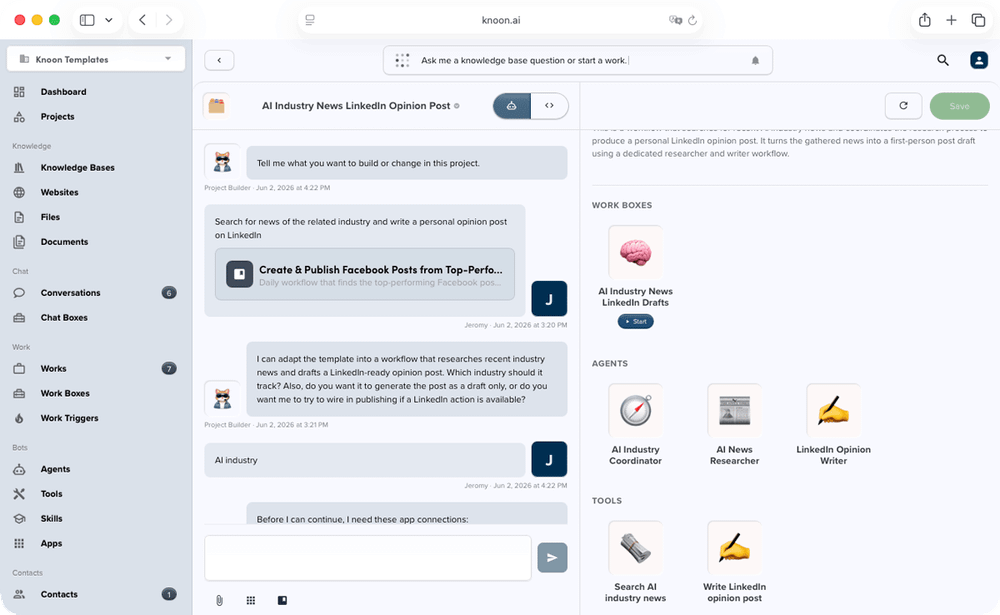
Instead of learning AI frameworks, configuring agents, managing integrations, and designing complex workflows, simply describe your business process in plain English. Agent Maestro helps translate that into the agents, tools, knowledge bases, workflows, and infrastructure required to run it.
For businesses that don't know where to start, we've also created hundreds of ready-made workflow templates based on real-world business use cases. Rather than building everything from scratch, you can start with a proven workflow and customize it to fit your business.
The future of AI-native businesses won't be defined by who built the most infrastructure.
It will be defined by who captured, refined, and operationalized their workflows most effectively.
Because in the end, the value has never been in the infrastructure.
The value is in the workflow.
And that's where businesses should spend their time.