
Is Your Business AI-Ready? What Is the AI Readiness Index (AIRI) and Why Every Business Should Care
Is your organization ready for AI? Many AI initiatives fail not because of technology, but due to gaps in people, processes, data, governance, and infrastructure. Learn how AI Singapore's AIRI framework helps assess AI readiness and identify opportunities for successful adoption.


Artificial Intelligence is no longer a future technology. It is already helping businesses automate work, improve customer experiences, and operate more efficiently.
Yet many companies struggle with the same question:
"Are we actually ready for AI?"
This is where the AI Readiness Index (AIRI) comes in.
Developed by AI Singapore, AIRI is a framework designed to help organizations assess their readiness for AI adoption. It was built based on hundreds of engagements with companies across different industries, sizes, and levels of AI maturity.
Why AIRI Exists
Many organizations approach AI by purchasing tools first and figuring out the use cases later.
Unfortunately, AI projects often fail because the challenge is not technology. It is usually a combination of people, processes, data, governance, and infrastructure.
AIRI provides a structured way to identify these gaps before significant investments are made.
Organizations are assessed across four maturity levels:
- AI Unaware
- AI Aware
- AI Ready
- AI Competent
The goal is not simply to score higher. The goal is to understand what needs to improve before AI can deliver meaningful business value.
An organization’s AI maturity may vary across different dimensions. Some areas may be well-developed, while others require further investment and improvement. Collectively, the five AIRI pillars provide a holistic assessment of an organization’s readiness to successfully adopt and scale AI across the business.
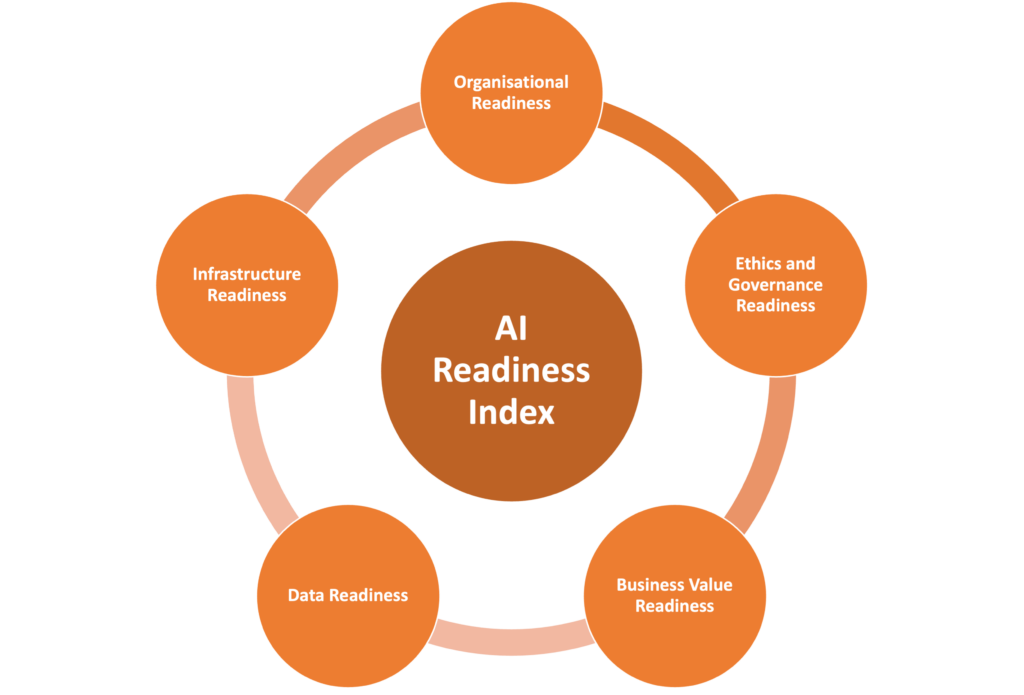
| Pillars | Dimensions | Assessments |
|---|---|---|
| Organisational Readiness | Management Support | Whether the organisation has allocated resources for AI initiatives. |
| AI Literacy | Whether employees can identify potential AI use cases and effectively consume AI solutions. | |
| AI Talent | Whether the organisation has the capabilities to develop, integrate and maintain AI models. | |
| Employee Acceptance of AI | Whether employees trust and accept AI-based systems. | |
| Experimentation Culture | Whether the organisation has a culture that encourages experimentation and exploration of AI use cases. | |
| Ethics & Governance Readiness | AI Governance | Whether the organisation has appropriate governance to avoid unintentionally harming end-users. |
| AI Risk Control | Whether the organisation has proper classification and management of AI system risks. | |
| Business Value Readiness | Business Use Case | Whether the organisation has identified suitable AI use cases and assessed their value propositions. |
| Data Readiness | Data Quality | Whether the organisation has processes to ensure the accuracy and completeness of data. |
| Reference Data | Whether there is a single source of truth, consistent data formats and reliable metadata. | |
| Infrastructure Readiness | Machine Learning Infrastructure | Whether sufficient ML infrastructure (GPU, compute, memory) exists to support AI training and deployment. |
| Data Infrastructure | Whether appropriate data infrastructure such as data lakes and central repositories are in place. |
Understanding the AIRI Maturity Levels
Many small and medium-sized businesses assume they are not ready for AI because they do not have data scientists or AI engineers.
In reality, most SMEs score lower not because of technology, but because of process maturity.
Common challenges include:
- Workflows that only exist in employees' heads
- Lack of documented operating procedures
- Information scattered across email, spreadsheets, and messaging apps
- No clear ownership of business processes
These issues affect AI adoption far more than the choice of AI model. As AI agents become more capable, readiness becomes even more important. AI agents do not simply answer questions. They perform work.
They can:
- Process invoices
- Update CRM systems
- Generate reports
- Follow business procedures
- Coordinate tasks across teams
For AI agents to operate effectively, organizations need clearly defined workflows, decision rules, and access to reliable information.
In other words, companies must first understand how work gets done before AI can help execute it.
| AI Unaware | AI Aware | AI Ready | AI Competent | |
|---|---|---|---|---|
| Average Score | Less than 2.5 | 2.5 to 3.4 | 3.5 to 4.5 | Greater than 4.5 |
| Interpretation | Organisation might hear about AI, but is unaware of AI applications. | Organisation is aware of AI applications and could identify potential use cases. | Organisation can integrate pre-trained AI models into products and processes. | Organisation can develop customised AI solutions for specific business needs. |
| Characteristics | Exploring AI concepts and consuming ready-made AI solutions. | Identifying AI opportunities and evaluating use cases. | Using AI APIs and integrating AI into workflows. | Having an AI strategy and building customised AI solutions. |
| Recommendation | Increase AI literacy across the organisation. | Adopt ready-made AI solutions. | Integrate AI into core workflows. | Scale AI capabilities across departments. |
| KNOON PLATFORM & SERVICES | ||||
| Advisory | Private Consultation | |||
| Training | AI Fundamentals, Prompt Engineering & AI Agent Adoption Workshops | |||
| Capabilities | Knowledge Bases, AI Agents, Multi-agent Orchestration, No code & Human-in-the-Loop Workflows | |||
| Innovation | Workflow Templates & Agent Maestro | |||
| Data & Tools | Integrations, AI Search & Business Tools | |||
How Knoon Helps Organizations Progress Through the AIRI Maturity Levels
The AI Readiness Index (AIRI) provides a useful framework for understanding an organization's AI maturity. However, moving from awareness to implementation is often where many businesses struggle.
Most organizations do not lack access to AI tools. They lack the workflows, knowledge, integrations, and infrastructure needed to put AI into daily operations.
This is where Knoon helps.
Stage 1: AI Unaware → AI Aware
At the earliest stage, organizations are still learning what AI is and how it can create value. Teams are exploring AI concepts, experimenting with tools like ChatGPT, and trying to understand where AI fits into their business.
Knoon helps by providing practical guidance, real-world examples, and AI fundamentals training that focuses on business outcomes rather than technical complexity.
Stage 2: AI Aware → AI Ready
Once organizations begin identifying potential AI use cases, the challenge becomes turning ideas into working solutions.
Knoon helps businesses move beyond experimentation through:
- AI Fundamentals Training
- Prompt Engineering Workshops
- AI Agent Adoption Workshops
- Private Consultation and AI Planning
Rather than asking businesses to learn complex AI infrastructure, Knoon focuses on helping teams identify high-value workflows that can be automated and improved.
Stage 3: AI Ready → AI Competent
Organizations at this stage have moved beyond isolated AI experiments and are looking to integrate AI into core business processes.
Knoon provides the building blocks required to operationalize AI:
- Knowledge Bases
- AI Search
- AI Agents
- Human-in-the-Loop Workflows
- No-Code Workflow Automation
- Business Integrations
This allows organizations to deploy AI solutions that can reliably execute work, access company knowledge, and interact with existing systems.
Scaling AI Across the Organization
As organizations mature, the focus shifts from individual AI projects to organization-wide AI capabilities.
Knoon's advanced capabilities support this transition through:
- Multi-Agent Orchestration
- Workflow Templates
- Agent Maestro
- Cross-System Integrations
- Enterprise AI Governance Workflows
Instead of building AI solutions from scratch, businesses can describe how work gets done and use Knoon to transform those workflows into AI-powered operations.
Becoming an AI-Native Business
The most successful organizations are not necessarily the most technical. They are the ones that can clearly define their processes, capture institutional knowledge, and continuously improve how work gets done.
Knoon helps organizations at every stage of the AIRI maturity journey by providing the infrastructure, agents, workflows, and tools needed to turn business processes into scalable AI-powered operations.
You focus on defining the workflow.
Knoon provides the AI infrastructure to execute it.
A Simple Test to Check Your Organization’s AI Readiness
Ask yourself: "Can a new employee perform this process successfully if we explain it step-by-step?"
If the answer is yes, you are likely much closer to AI readiness than you think.
If the answer is: "Only John knows how to do it."
Then your first AI project may not be automation.
It may be documenting and standardizing the process itself.
The biggest misconception about AI is that success starts with technology.
AIRI shows that successful AI adoption starts with readiness.
The organizations that benefit most from AI are not necessarily those with the largest budgets. They are the ones with clear processes, quality data, supportive leadership, and a willingness to experiment.
Before asking which AI model to use, it may be worth asking a simpler question:
"Is our organization ready for AI?"