

What Is Model Context Protocol (MCP)? Limitations, and the Real Work Behind AI Integration

AI is becoming increasingly capable, but connecting it safely to real world systems remains a major challenge for most businesses. The Model Context Protocol, or MCP, was introduced to standardise how AI interacts with external tools. MCP allows AI models to discover capabilities, call actions, and receive structured results in a predictable format.
But MCP alone does not solve the practical realities of deploying AI inside a business. Companies operate with three distinct roles: owners, employees, and customers. Each role requires different permissions, responsibilities, and strict separation of information. The agent that calls MCP tools has no built in understanding of who the end user is, whether a business owner, an internal employee, or a public customer. MCP itself does not enforce roles, permissions, sensitive data rules, or departmental boundaries. All of these controls must be engineered separately by the business or platform using MCP.
This article explains what MCP is, why it matters, and why the real challenge is not the protocol, but the engineering required to use it safely in real organisations.
What Is MCP?

MCP, or Model Context Protocol, is an open standard that defines how AI models should interact with external tools. Instead of every integration using a different structure, MCP provides a consistent format for tools to describe what they can do, the inputs they need, and the outputs they return.
In simple terms, MCP is a shared language that lets AI and tools communicate clearly.
Why MCP Was Created
Before MCP, integrations were inconsistent and repetitive. Developers had to adapt every API to every AI model manually. Reading documents, updating spreadsheets, or scheduling meetings each required custom engineering.
MCP attempts to fix this by offering a standard way for tools to declare capabilities. This makes integrations more predictable and reduces repeated work.
How MCP Works
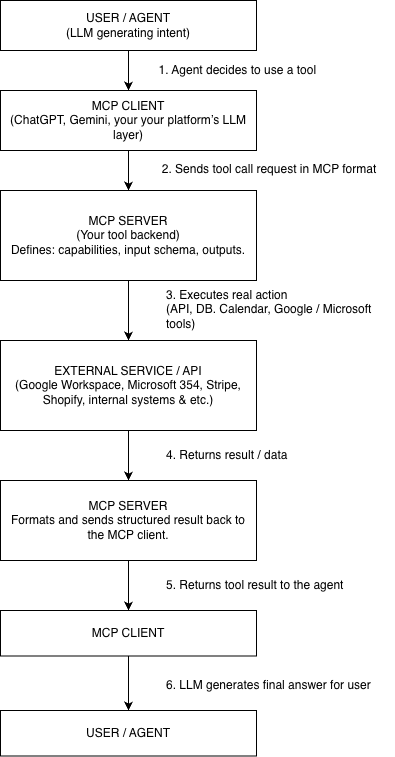
MCP consists of three parts. The AI model acts as the client. The MCP server exposes tools that define what actions they can perform. The protocol describes how the client and server exchange messages.
When a user connects an MCP server, the AI discovers the available tools. It understands what operations can be performed and requests permission from the user when necessary. The server carries out the action using its own authentication and returns only the final result back to the AI.
In design, MCP is clean and minimal. It intentionally avoids defining authentication systems, access control, data filtering, or user interface behaviour. These responsibilities must be handled by developers and AI platforms on top of the protocol.
Why MCP Alone Is Not Enough
MCP is clean and well designed, but using it inside a real business still requires significant engineering and careful security work. MCP is not the problem. The problem is everything surrounding it.
Authentication requires custom implementation. MCP does not offer a central login system or organisation wide OAuth flow. Developers must build their own credential system, token storage, and login UI for each service.
Role based access must be engineered manually. MCP does not distinguish between owners, employees, or customers. Without additional logic, an employee facing agent could access owner level tools, and a customer facing agent could see internal business data. MCP leaves permission boundaries entirely up to the developer.
Approval flows require custom UI and backend logic. Actions that modify data, send emails, or update calendars need human approval. MCP does not implement queues, admin dashboards, or audit histories, so developers must create these systems themselves.
Tool responses often need significant shaping. Many APIs return raw or noisy data that the AI cannot use effectively. Developers must design summaries, safe structures, and contextual representations for the model.
Sensitive information requires a protection layer. Tools may have full access to account data, but agents should only see safe fields. Developers must build redaction filters, safe projections, and ID based references so the model never receives confidential information by mistake.
In other words, MCP provides the transport, but the business must still build everything around it: authentication, permissions, role separation, redaction, tooling UI, and internal governance.
How Knoon Solves These Engineering Challenges
Knoon removes all of the surrounding engineering effort required to use MCP easily. Instead of writing your own tool servers, redaction logic, permission system, authentication flows, or approval dashboards, businesses simply connect their services and begin using agentic capabilities immediately.
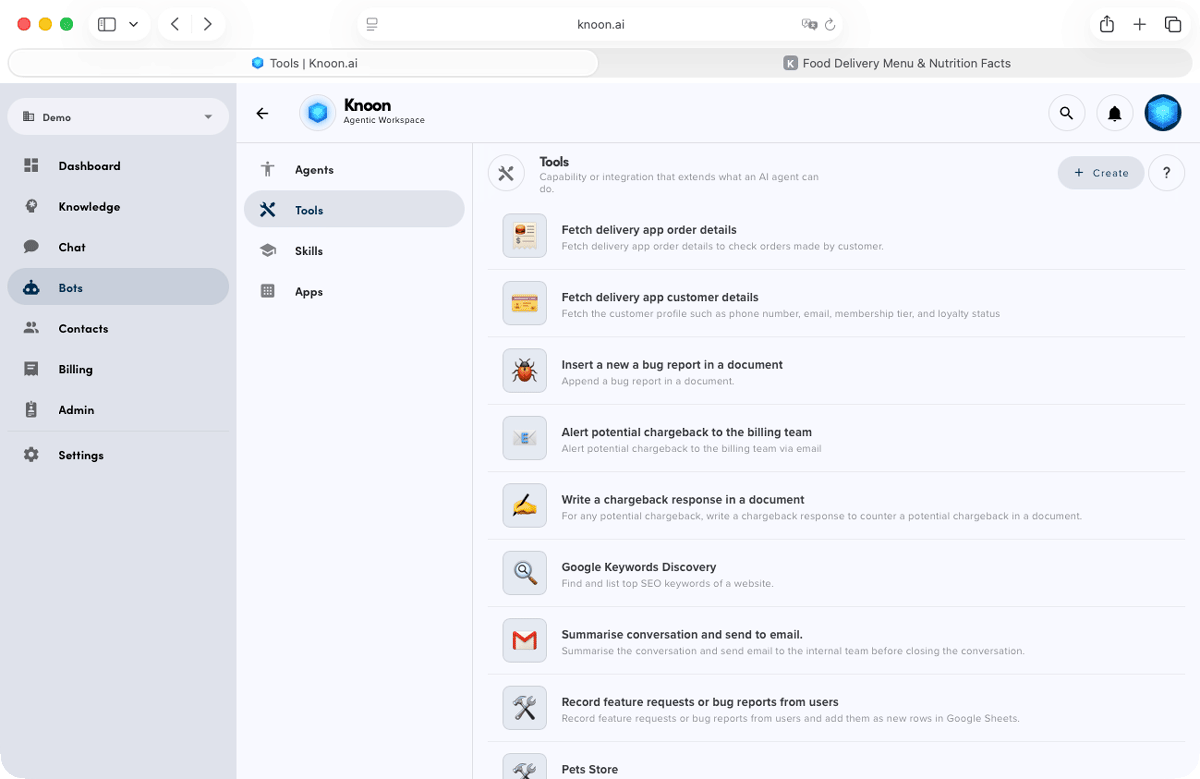
Knoon integrates with Google Workspace, Microsoft 365, Shopify, WordPress, Ghost, WhatsApp, and many more platforms through a unified experience. It handles login, token storage, safe data shaping, permission enforcement, and high quality tool responses automatically. Sensitive fields are protected before they reach the agent.
Knoon is built from the ground up for the three roles found in real businesses. Owners control the organisation and connected systems. Employees are restricted to the tools and data relevant to their department. Customers interact only with public features such as bookings or enquiries. Each role sees a separate and isolated view, ensuring no accidental data leakage.
With Knoon, businesses can use agentic AI without learning MCP, coding infrastructure, or building any internal security systems. Everything from authentication to safe views to tool management is fully handled.
MCP provides a valuable foundation for standardising how AI communicates with external tools, but it is only one piece of a much larger puzzle. Real businesses need authentication flows, permission systems, safe data handling, role separation, and robust interfaces that MCP does not provide. The difficulty lies not in the protocol, but in the engineering required to deploy it securely and reliably across owners, employees, and customers.
Knoon bridges this gap by delivering a complete, ready to use solution that handles authentication, permissions, data shaping, and multi role separation out of the box. With Knoon, organisations can harness agentic AI safely and effectively without building the underlying infrastructure themselves.